Showing posts with label seafood. Show all posts

28 August 2011

Grilled Maple-Chili Salmon

This was my play on words.  We grilled our salmon up on cedar planks so called it Cedar PLANKed Salmon to go along with the pirate theme.  It was Chris and my first time using cedar planks so we're just glad it didn't catch fire on the the grill :D.  I LOVED the way that this dish turned out.  The flavor was fantastic and I will for sure be making this again.

We bought a gigantic wild salmon filet from Costco and the maple syrup that I used came from one of our new Dinner Club members, Delia.  She hails from the border of NY and VT so gets some of the best maple syrup.  Scott was skeptical when he saw me drizzling it on as the finishing touch.  I could see it in his eyes lol.  But I think it's safe to say he's converted.  The sweet, smokey, and savory is a wonderful combination.

Grilled Maple-Chili Salmon
Yields: 3-4 servings


Ingredients

  • 1 lb salmon, cut into 3-4 filets
  • 1 tsp chili powder
  • 1/2 tsp paprika
  • 1/2 tsp cumin
  • 1/8 tsp garlic powder
  • 1/8 tsp cinnamon
  • 1/4 tsp salt
  • Fresh ground black pepper
  • 1 Tbsp creole mustard (or any spicy brown mustard)
  • 1 Tbsp olive oil
  • 3-4 tsp maple syrup
Directions


  1. If using, soak the cedar plank per the manufacturer instructions.
  2. Stir together the dry ingredients and then stir in the olive oil and mustard.
  3. Spread the rub over the top and sides of the filets and let sit while the grill heats.
  4. Preheat grill to medium-high.  Place fish on the soaked plank and cook for ~15 minutes, until the fish flakes and the internal temperature reaches 140.  If not using the plank, place skin side down and cook 8-10 minutes.
  5. Remove from heat and immediately drizzle each filet with ~1 tsp of maple syrup.
Source: Confections of a Foodie Bride

10 January 2010

Sushi

Below are the basic ingredients for sushi.  You can then buy fillings of your choice to make various delicious rolls. 

I highly suggest Sushi Day for inspiration and recipes...there's even some rolls with BACON! (Bacon Crunchy Shrimp Roll and Kristen Maki). 

Pioneer Woman has an awesome tutorial with really good pictures (very helpful if you're a visual person like I am!) on how to create your rolls.  There's also a few good recipes on there as well.


Mmmm...good thing Emily took pictures of my rolls because I forgot to!

As I wasn't sure how adventures our group of Dinner Clubbers would be, I opted for all cooked (and inside out so you can't see the nori (seaweed) - out of sight, out of mind right?) maki rolls.  For my rolls, I made the standard California Roll and then did some Spicy Crab Rolls and just a few Shrimp Rolls.

Sushi Rice
(Source: Cody the Sushi Chef as seen on Pioneer Woman)


Prep Time: 30 minutes
Cook Time: 20 minutes
Yields: 8 cups cooked rice or about 16 rolls

Ingredients
  • 4 cups Short Grain/sushi Rice, uncooked
  • 1 cup Rice Wine Vinegar
  • ½ cups Sugar
  • ¼ cups Sake Or Mirin (a Japanese Rice Wine)
Note: Used seasoned rice wine vinegar instead of sushi su (vinegar + sugar + sake).

Instructions

“Rice Prep”
  1. Use short or medium-grain rice. It’s more starchy and round than the long-grain variety, which just won’t hold together well enough to support ingredients in sushi. Many stores now sell specifically-labeled “sushi rice”.
  2. Before you cook it, wash/rinse the rice until the water runs totally clear—about five or six times. If you don’t thoroughly rinse the rice, it’ll end up in a big, sticky ball. There’s enough internal starch in the rice for it to sufficiently hold together for sushi, so get all the stuff on the outside off by rinsing well.
  3. Use a rice cooker/steamer. Rice made on the stovetop will not work for sushi; it won’t be the right consistency. Rice cookers are widely available for as low as $12.
  4. Add the rinsed rice to the rice cooker with equal parts water, and follow the directions for the rice cooker. After it’s done, transfer the cooked rice to a large mixing bowl.
You’ll need 1 part sushi su for every 4 parts rice.

Sushi Su/Sushi Rice:
  1. Heat vinegar, sugar, and sake or mirin in a saucepan just to dissolve and combine. Allow to cool to room temperature. (Note: skipped this step as I just subbed pre-made seasoned rice wine vinegar)
  2. Cook rice according to rice cooker directions. Transfer to large mixing bowl.
  3. Pour su (vinegar mixture) over the rice, gently folding to incorporate.
  4. Let rice stand for 10 minutes, then fold again.
Rice should be shiny, not mushy and have a slightly tart/sweet taste. Cover with a warm, wet towel and keep warm.

Spicy Mayonnaise
(Source: Group Recipes)


Ingredients
  • ½ cup (low-fat) mayonnaise
  • 2 Tbsp Sriracha hot sauce
  • ¼ tsp roasted sesame oil
Directions
  1. Whisk the ingredients together until well blended.
  2. Store in fridge until ready to use.  Use in rolls or as a dipping/drizzled sauce.
California Rolls
(Source: Pioneer Woman)


Ingredients and Supplies
  • 1 piece Makisu (bamboo Rolling Mat)
  • Dark Green Nori (dried Seaweed)
  • Sushi Rice (recipe above)
  • Imitation Crab (round leg style)
  • Avocado, Thinly Sliced
  • Cucumber (Japanese, If Available), Thinly Sliced
  • Toasted Sesame Seeds
  • Soy sauce, for dipping
  • Wasabi, if desired (used prepared Wasabi in a tube that I bought at Kroger)
  • Ginger, if desired
Instructions

  1. First, in order to keep your rice from sticking to the Makisu and making a terrible mess, carefully wrap the Makisu in plastic cling wrap.
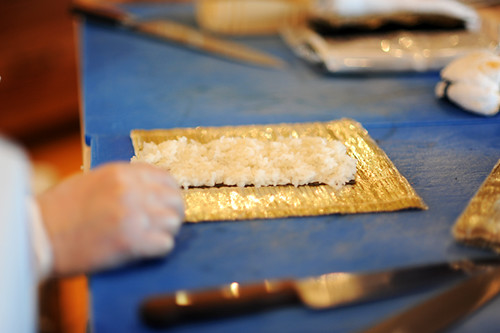
  2. To begin, fold the pieces of nori in half to split them. Nori is very delicate, so as soon as you press along the seam, it easily breaks in two. Next, lay the half-sheets of nori on the work surface and grab a handful (about a ½ cup) of sushi rice and cover one side of a half-sheet of nori with it. To do so, first set the rice on the end of the nori sheet closest to you. Then, working with your fingertips and/or knuckles, gently spread the rice over the surface of the nori.
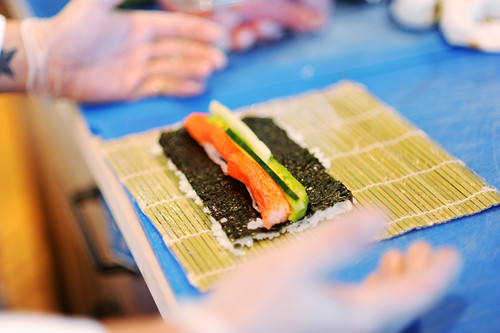
  3. On California Rolls, the rice is typically on the outside – not the inside – so to begin, quickly flip the rice-coated sheet of nori so that the rice side is down. Carefully position it horizontally so it will roll lengthwise. Next, place a single row of the crab across the middle of the nori. Next, place slices of avocado end to end right against the crab. It’s best to use an avocado that’s ripe but still quite firm. Lastly, lay the very thin (slightly thicker than a matchstick) cucumber slices end-to-end right alongside the crab and avocado.
  4. To roll the sushi, carefully lift the edge of the mat closest to you, begin rolling the mat away from you, pressing it lightly to keep it firm. At this point, the end of the roll has been rolled upward, and your very light pressure is ensuring that they roll will remain nice and tight. Next, lift up the end of the rolling mat and pull it away from you, allowing the roll to roll the rest of the mat. Then carefully remove the roll from the mat and place it on a cutting board. Lay the mat over the top of the roll and exert gentle pressure once more to make sure it’s all secure.
  5. Next, hold the roll on the mat and sprinkle the top with toasted sesame seeds. Slice using a very sharp knife, first running the knife through a damp dishtowel with the blade facing away from you. Begin by slicing the roll exactly in half. Then set the two halves side-by-side to slice into individual pieces. This ensures that each piece will be a uniform size.
  6. Wrap in plastic cling and store in refrigerator until ready to serve.  Serve with soy sauce, wasabi, and pickled ginger, if desired.
For the Spicy Crab Rolls I just shredded some imitation crab and then mixed with the spicy mayonnaise.  Added some avocado and cucumber.  For the Shrimp Rolls I used cocktail shrimp (cut in half lengthwise), a dab of spicy mayo, carrots, and avocado.

Pajeon - Korean Pancake!

Pajeon- Korean Pancake

Adapted from whats4eats and DavidLebovitz


Another Actual pic! Order this up at most Korean places as an app! Or just eat it as a snack-meal! You can put anything you want in it- we picked seafood, but you can put kim chi, meat, anything! (i was just thinking about it, don't try fruit or chocolate or candy pieces)

Ingredients: (Makes one 9-inch (23cm) pancake)
1/2 cup (70g) all-purpose flour
1/2 cup (125ml) ice-cold water
1/2 teaspoon salt
1 large or extra-large egg, lightly beaten
1 bunch of scallions
a spoonful of soy sauce
optional: dried red pepper slices
additional: prawns, squid, crab, chicken, corn, bits of seaweed, tofu, mushroom slices, kimchi, asparagus slices, or some other cooked or shredded vegetables

Procedure

Tip - I find a non-stick skillet yields best results, but if you use a cast iron, be sure to add enough oil to prevent the pancake from sticking. I use relatively high heat since I want a nice, browned crust.

1. Stir together the flour, water and salt until just mixed.
2. Chop the green parts of the scallions into 3-inch (10cm) lengths. Reserve the white parts for another use
3. Heat a thin layer of vegetable oil in a 9 or 10-inch (23-26cm) skillet, preferably non-stick, until hot. Fry the scallions until they're completely cooked through and soft. Add a touch of soy sauce to the pan when they're almost done, to season the scallions.
4. If using other ingredients, any vegetables, kimchi, or prawns—what have you‐add them now, then toss a few times to heat them through.
5. Pour the pancake batter over the scallions (and other stuff in the pan), spreading the batter, and cook a few minutes until the bottom is nice and brown underneath. Lift the edge to peek.
6. Pour the beaten egg on top then swirl the pan to even out the egg a bit, still keeping it pretty uneven. Distribute the dried pepper strands over the egg, if using, and cook until the egg is just beginning to firm near the edges.
7. Using a wide spatula, flip the pancake and cook for another minute or two until the egg is set and preferably crispy at the edges. (I tend it cook it pretty well, although I like hard-cooked fried eggs, which I know ain't "gourmet", so use your judgment.)
5. Slide pancake onto a cutting board, then cool to room temperature. Cut into six or eight wedges, and serve with dipping sauce made by mixing 3 parts soy sauce with 1-2 parts rice vinegar and a few drops of sesame oil. A bit of chile oil can also be added.

14 December 2009

Annapolis Crab Cakes

Annapolis Crab Cakes

1 pound of jumbo lump crabmeat (Phillip's brand from Jungle Jim's)
10 saltines, crushed (to make a paste-like consistency)
2 tbsp mayonaise
2 tsp Old Bay Seasoning
2 tsp parsley flakes
1/2 tsp prepared yellow or dijon mustard
1 egg, beaten
Worcestershire Sauce to taste
Crush saltines into small pieces. Mix in mayonaise, Old Bay, parsley, mustard, egg and Worcestershire Sauce. Stir in crabmeat. Shape into patties. Broil or fry until golden brown
Makes about 20 appetizer-sized or 8-10 entree sized

Chicken, Sausage & Seafood Gumbo

Chicken, Sausage & Seafood Gumbo


Some key points/tips:
1) For the roux, I recommend using any kind of seafood stock, but you can use a mixture of flour and water and other seasonings if you choose.
2) Remember to use a non-reactive (non-cast iron) pot for any gumbo (I didn't even know this, found this tip on the website) that includes tomatoes, as they will discolor.
3) Do not use imitation crab/seafood meat!
4) There are many different ways to make Gumbo. My way is how my mom used to make it when I was a young lad with a little extra to give it flare! I hope you enjoy making this delicious dish!
5) As with cooking any other dish, don't feel weird if you begin to talk to yourself and the ingredients or begin to speak with an accent (lol, it's not just me is it...)

Got some helpful tips, references and inspiration from this website: http://www.gumbopages.com/food/soups/seafood-gumbo.html

1/2 cup oil
1/2 cup flour
1/2 medium white onion, diced
1/2 medium yellow (sweet) onion, diced
1-2 green bell peppers, diced
3 ribs celery, finely diced
4 cloves garlic, minced
4 tomatoes (or 8 Roma tomatoes), seeded and diced (if you like tomatoes in your gumbo - I used 4 Roma tomoatoes)
4 quarts seafood stock (may not need to add all 4 quarts, monitor liquid level and adjust accordingly.)
1 quart lobster stock (kick it up a notch...BAM!)
1 tablespoon Old Bay Seasoning (adjust to taste; may need more or less depending on your taste preference)
1/2 teaspoon of Cayenne Pepper
1/2 teaspoon of Lemon Pepper
1 teaspoon dried thyme leaves
2 bay leaves
Salt and black pepper to taste
4 skinless chicken breast, cubed
2 chicken legs, 2 chicken thighs, remove from bone and cube (not needed, but I threw it in for added chicken flavor)
1 pack of smoked sausage (2 in a pack), slice 1/2 inch thick slices
2 pounds medium shrimp, peeled and deveined
1 pound of fresh backfin crabmeat (I used Phillips Brand - Jungle Jim's)
1 pound fresh lump crabmeat (I used Phillips Brand - Jungle Jim's)
1 tablespoon flour (for thickening if needed during cooking - gumbo liquid should be thicker than broth, but less viscous than chowder; almost like a bisque consistency)
2 cups cooked long-grain white rice (adjust based on # of servings)

Note: Amounts can be adjusted to accomodate larger or smaller parties. Constantly taste Gumbo throughout the cooking process as to correctly adjust seasonings.

In a large pot, heat the oil and add the flour. Stir constantly until a light brown roux is formed, then add the onions, bell pepper, celery and garlic. Sauté until the onions become translucent and the vegetables are tender. Add the tomatoes and cook over medium heat for 10 minutes. Add the seasonings, and about 1/2 teaspoon each of salt and pepper, and continue to cook another 10 minutes. Add the stock. Bring to a boil, then reduce heat to simmer and cook another 45 minutes. (Make sure to taste Gumbo during seasoning process and adjust accordingly)

While Gumbo is simmering, cook chicken breast, leg and thigh cubes in a non-stick pan with a little olive oil. Lighly season chicken with Old Bay seasoning, pepper and a little lemon pepper (this can be ad-libed as you don't want the chicken to over-power the gumbo). Transfer cooked chicken to the Gumbo.

In the same pan, cook the smoked sausage and transfer to Gumbo.

With the gumbo on very low heat, add the shrimp and backfin crabmeat 10 minutes before serving and the lump crabmeat just before serving (don't cook the crabmeat, just stir until it is brought to temperature of Gumbo - this is the part I forgot to do, as I left crabmeat at home lol!).

Add additional stock/flour to thin or thicken the Gumbo. Taste and adjust seasonings.

Let stand for 15 minutes.

Place about 1/2 to 2/3 cup of rice into bowl or plate and ladle the gumbo over and around it.